


British silver hallmarks are small marks with a practical purpose.
They can help identify the standard of silver, the assay office involved, the sponsor responsible for submitting the article for hallmarking and, where present, the year in which the article was hallmarked.
For collectors of vintage jewellery, hallmarks are useful. They can support a description, help date a piece by hallmarking year and add confidence when assessing metal, construction and condition.
They should not, however, be read in isolation. A hallmark is not the whole story of a jewel.
This guide explains British silver hallmarks in a practical way, with particular attention to vintage jewellery, small silver pieces, charms, bracelets, pendants and cufflinks.
For a concise overview of the house’s hallmarking position, future production and official Dealer’s Notice, see Hallmarking at Links London.
Hallmarking Is About Description as Well as Marks
A common misunderstanding is that all silver jewellery must be hallmarked.
The position is more careful than that.
UK hallmarking law controls how precious metal articles are described and supplied in trade. In broad terms, a business must not describe or offer an unhallmarked article as silver, gold, platinum or palladium unless the article or description falls within an exemption or permitted category.
This distinction matters.
The law is not simply a rule that every small silver jewel must carry a full set of marks. It is a consumer-protection framework concerned with precious-metal descriptions, approved hallmarks, sponsor’s marks, exemptions, alterations and misleading fineness claims.
For customers, the useful point is this:
not every silver jewellery item will carry a full hallmark, and the absence of a visible hallmark does not automatically mean that a piece is not silver.
What Is a British Silver Hallmark?
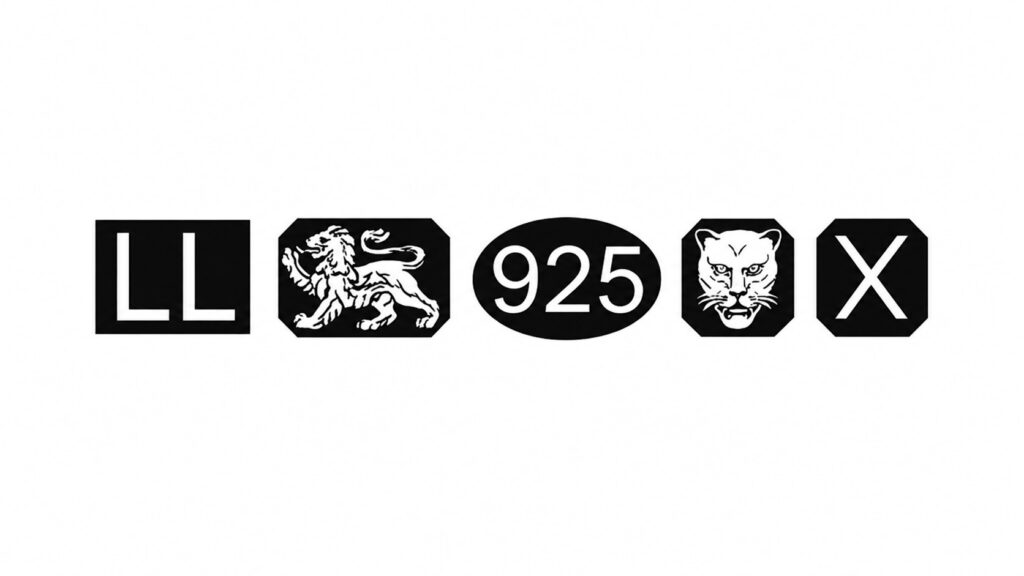
A British silver hallmark is a set of marks applied under the hallmarking system to an article of silver.
In normal customer terms, it can help show that the article has been assessed for precious metal fineness by an assay office.
On jewellery, hallmarks are often very small. They may appear on a clasp, charm, bracelet link, pendant bail, ring shank, cufflink fitting or another discreet part of the piece.
On vintage jewellery, they may be clear, worn, partial, rubbed, hidden by construction or difficult to read.
What a Hallmark Can Tell You
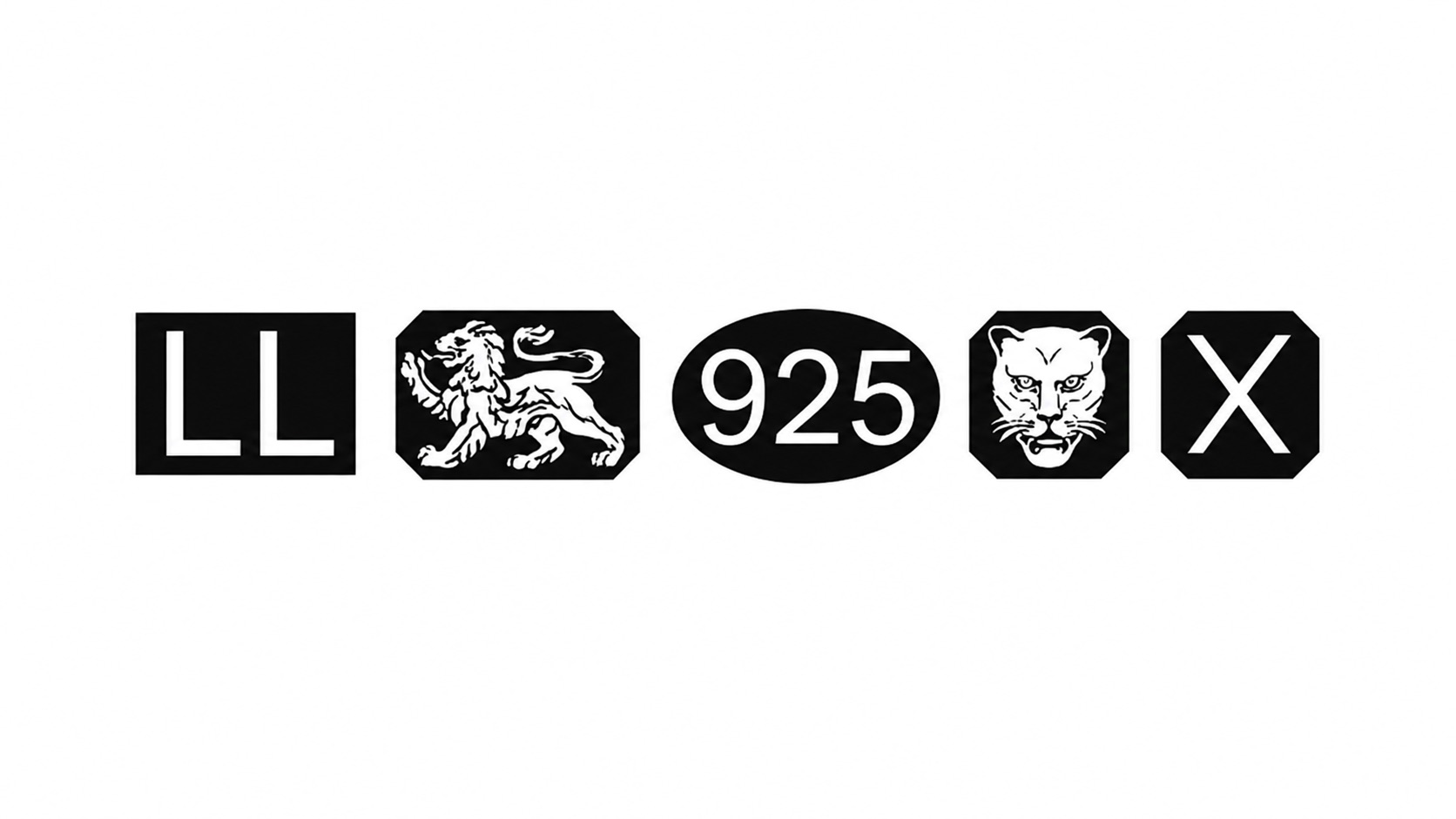
A British silver hallmark may help identify:
- the silver standard;
- the assay office;
- the sponsor’s mark;
- a date letter, where present;
- sometimes a traditional pictorial mark.
It can support the description of a piece as silver or sterling silver, where the mark is present and legible.
It can also help distinguish between a metal description and a brand description. Those are not the same thing.
A hallmark may tell us something about the metal and the hallmarking process. It does not automatically tell us the full provenance, retail history or ownership history of the piece.
Sponsor’s Mark
A sponsor’s mark identifies the person or organisation responsible for submitting the article for hallmarking. It does not necessarily identify the designer or physical manufacturer.
This is sometimes casually called a maker’s mark, but that can be imprecise. A sponsor’s mark does not necessarily prove who physically made the article. It identifies the registered sponsor connected to the hallmarking submission.
For vintage jewellery, the sponsor’s mark is useful evidence, but it should be read alongside the rest of the piece.
Fineness Mark
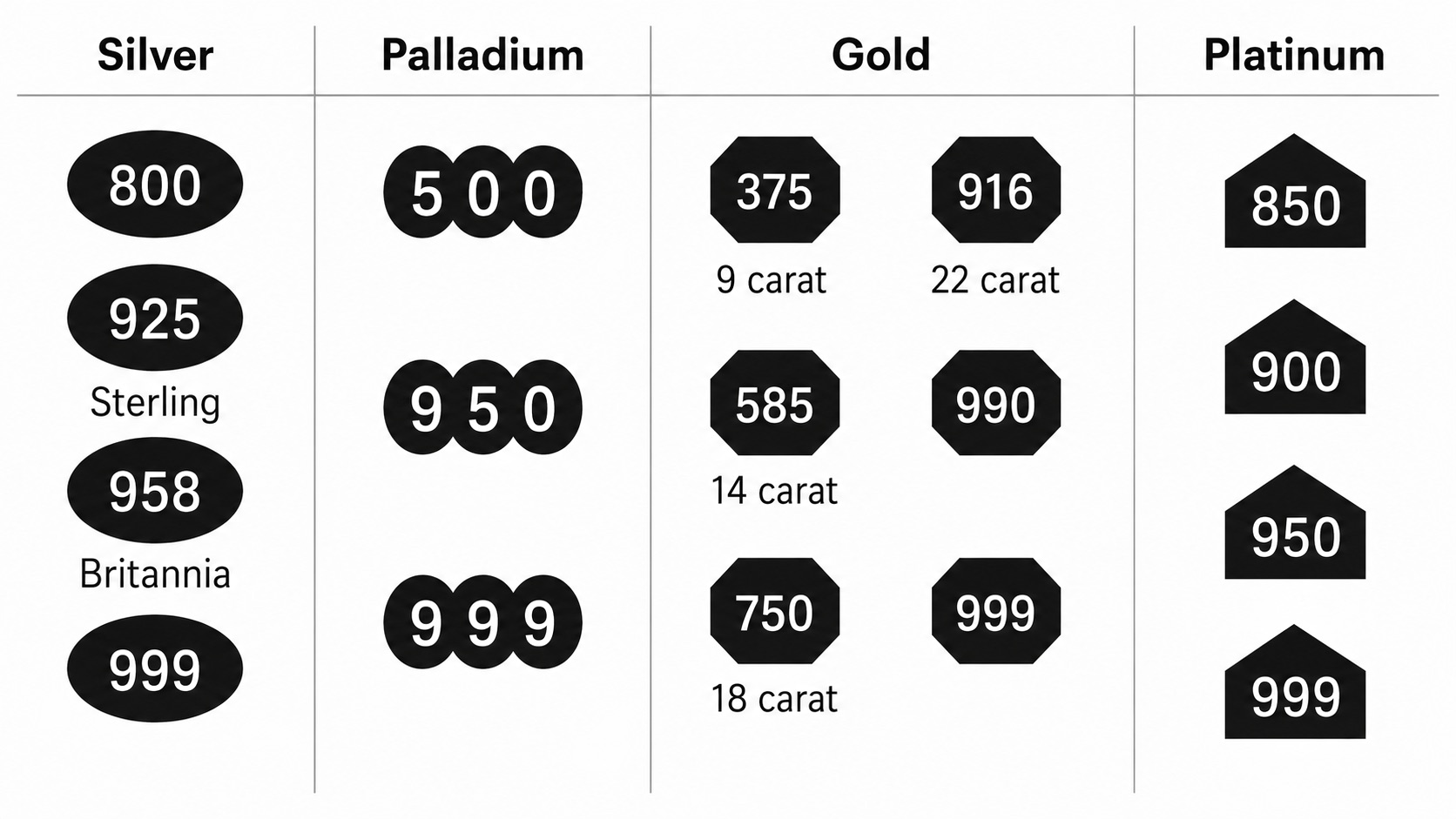
The fineness mark shows the standard of precious metal.
For sterling silver, the familiar mark is:
925
This means 925 parts silver per thousand.
Assay Office Mark
The assay office mark identifies the assay office.
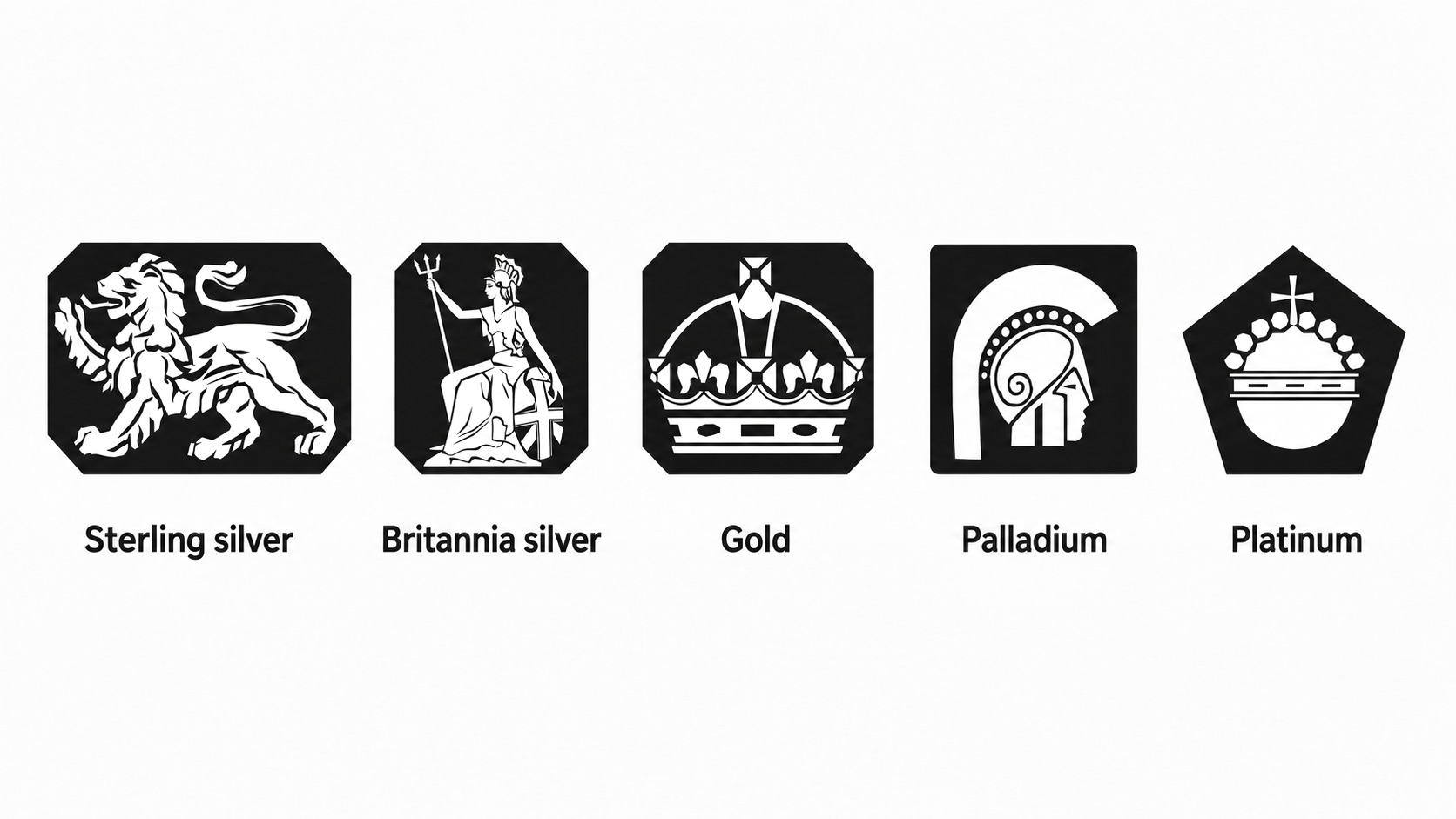
The main UK assay office marks are:
- London — leopard’s head;
- Birmingham — anchor;
- Sheffield — rose;
- Edinburgh — castle.
The assay office mark tells you where the article was tested and marked. It does not, by itself, tell the whole history of a jewel.

Date Letters and Optional Marks
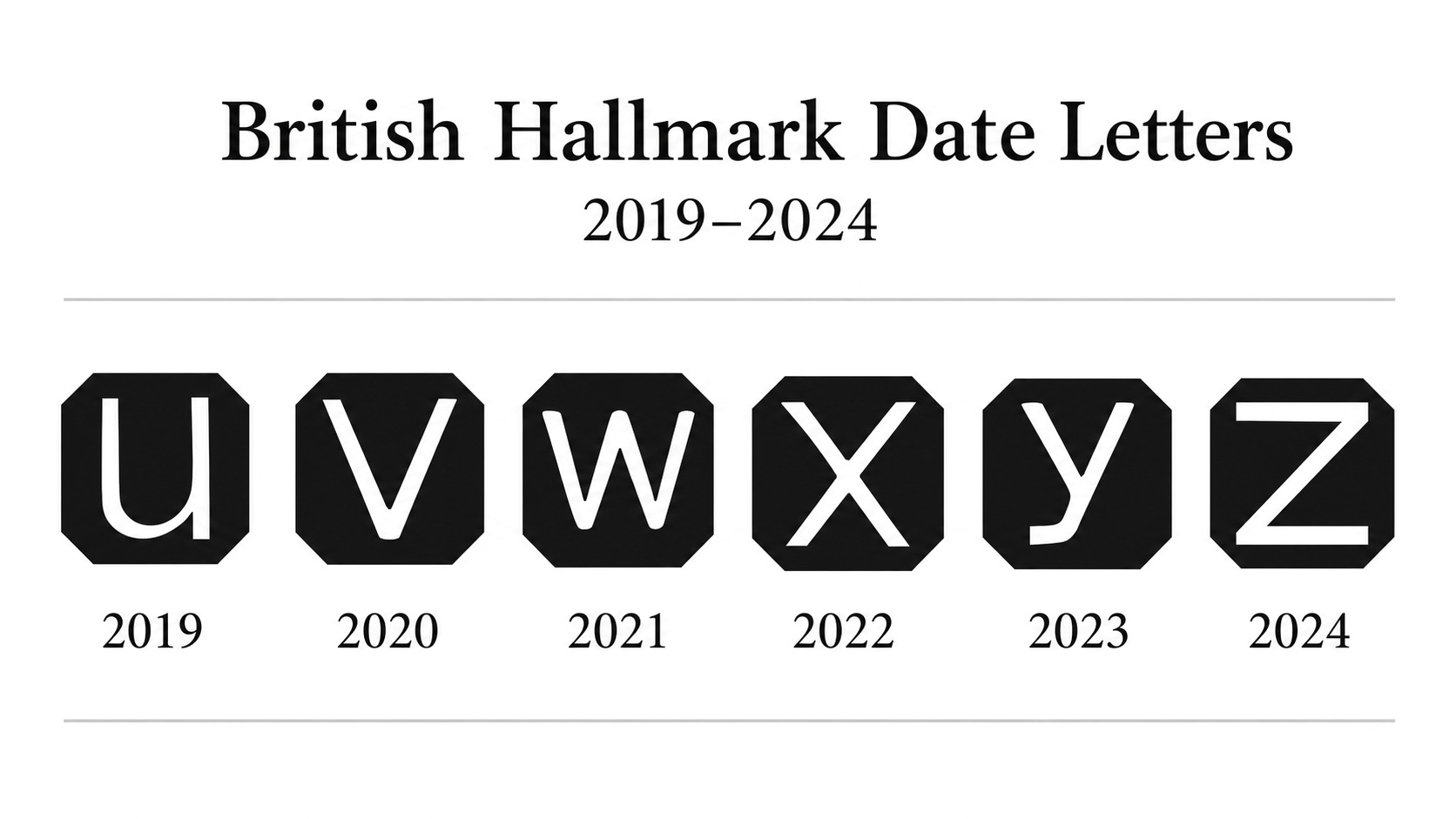
Some hallmarks include a date letter.
A date letter can indicate the year in which the article was hallmarked. It should not automatically be treated as the design launch date, retail sale date or exact date of manufacture.
This is especially important for vintage jewellery. A piece hallmarked in a particular year may have been sold later, remained in production across multiple years or belonged to a design family introduced at another time.
Some traditional marks and date letters may be optional depending on the period and system being used. The absence of a date letter does not automatically mean that a piece is unhallmarked.
A careful product description should therefore say:
hallmarked with a date letter for 2005
rather than:
released in 2005
unless there is separate evidence for the release date.
What Does 925 Mean?
925 means sterling silver.
Sterling silver is an alloy containing 92.5% silver. The remaining 7.5% is made up of other metals, usually to give the silver greater strength and durability.
Pure silver is relatively soft. Sterling silver is widely used for jewellery because it combines silver content with practical wearability.
British hallmarking recognises more than one silver standard. 925 is the standard associated with sterling silver and is the one most familiar to jewellery customers, but other silver standards also exist.
Small Silver Jewellery and the 7.78g Exemption
Small silver jewellery needs careful explanation.
For silver, the key exemption weight is 7.78 grams, subject to the article’s materials, construction and the conditions of the law. Some small silver articles may fall below that threshold.
This is especially relevant to charms, links, fittings, small pendants and lightweight components.
The important point is not that small pieces are never hallmarked. It is that they may not legally require a full hallmark in the same way as heavier silver articles.
Many jewellery businesses have still chosen to hallmark small pieces voluntarily as a matter of quality, traceability and customer confidence.
Voluntary Hallmarking on Links of London Jewellery
Many vintage Links of London silver pieces were hallmarked, including small items that may have fallen below the legal silver exemption weight.
That should be understood carefully.
Where a smaller piece carries a hallmark, the mark is useful. It may support the metal description, provide assay information and assist with assessment. But the presence of the hallmark does not necessarily mean the article was legally required to be hallmarked. It may reflect voluntary hallmarking as part of a quality and traceability practice.
Equally, the absence of a full visible hallmark on a small piece should not be read in isolation.
A small charm may be below the exemption weight. A mark may be worn. A component may be too small or awkwardly shaped to carry a clear full mark. A piece may require assessment through other evidence.
For The Vault, this is why each piece is considered as a whole.
Why Some Hallmarks Are Difficult to Read
Hallmarks on vintage jewellery can be difficult to read for several reasons.
They may have been small from the beginning. They may sit on a curved or moving part. They may be softened by wear, cleaning or polishing. They may be partly hidden by a clasp, hinge, bail or link. They may be present on one component but not another.
On a vintage piece, a hallmark may be:
- clear and complete;
- partly visible;
- worn but still useful;
- difficult to photograph;
- absent from a small component;
- present on the principal silver part but not on every attached part.
This is why product photographs, condition notes and measurements matter.
Hallmarks, Repairs and Alterations
Vintage jewellery may have been worn, repaired, restrung, polished or altered during its life.
Hallmarking law treats alterations seriously. A hallmarked article can be affected by additions, alterations or repairs, and the law contains rules around improper alteration and the removal, alteration or defacing of marks.
For customers, the practical point is simple:
repairs and replacement parts matter to description.
A bracelet may have been restrung. A clasp may have been replaced. A charm may have a later jump ring. A chain may not be original to a pendant. A surface may have been polished. These details do not necessarily make a piece undesirable, but they should be described where known, visible or relevant.
At Links London, restoration is approached as care, not as a reason to overstate condition.
Coatings, Vermeil and Mixed Materials
Jewellery can include more than one material.
A piece may include sterling silver, gold vermeil, plating, rhodium, enamel, leather, cord, elastic, gemstones or base-metal components. A hallmark should be read with the full product description.
A 925 mark may support the description of the silver part, but it should not be assumed to describe every visible surface, coating, fitting or later component.
This is particularly important for vintage jewellery, where replacement chains, restrung bracelets, added fittings or altered components may appear.
Does a Hallmark Prove Authenticity?
No. Not by itself.
A hallmark can be important evidence. It can help support a precious-metal description and may provide information about the assay office, sponsor and hallmarking year.
But a hallmark does not automatically prove:
- brand authenticity;
- provenance;
- retail origin;
- collection name;
- original packaging;
- uninterrupted ownership history;
- whether every component is original;
- whether a piece has been repaired or altered.
For vintage jewellery, a hallmark should be considered alongside design, construction, scale, proportions, fittings, condition, photography and comparison with known examples.
How We Describe Hallmarks in The Vault
In The Vault, we aim to describe hallmark information clearly and proportionately.
A product listing may refer to:
- visible 925 marks;
- sponsor’s or maker’s marks where present;
- assay office marks;
- date letters where present and legible;
- worn or partial marks;
- absence of a full visible hallmark where relevant;
- replacement chains or components where known.
The wording should reflect what can be seen and supported.
Examples of careful wording include:
marked 925
full UK hallmark including the 925 sterling-silver fineness mark
visible LL and 925 marks
hallmark partly worn
no full hallmark visible
small silver pieces may fall below the legal exemption weight
This is better than using hallmarking as a blanket claim.
This evidence-led approach forms part of The Vault, Authenticity & Care, where we explain how original pieces are examined, documented and prepared.
A Careful Way to Read a Vintage Silver Piece
When assessing a vintage silver jewel, it helps to ask:
- Is there a visible 925 mark?
- Is there a sponsor’s mark?
- Is there an assay office mark?
- Is there a date letter?
- Are the marks clear, worn or partial?
- Is the piece small enough that exemption may be relevant?
- Is the construction consistent?
- Are the scale and proportions right?
- Are the fittings original, later or uncertain?
- Are there signs of repair, restringing or polishing?
- Does the written description match the photographs?
This is a more reliable approach than relying on one mark alone.
Why This Matters for Vintage Links of London Jewellery
Vintage Links of London jewellery is often collected for its design, sentiment, scale and recognisable character.
Hallmarks can be an important part of assessing these pieces. Many were hallmarked, including smaller silver pieces where hallmarking may have been voluntary rather than legally required.
That makes the marks useful, but not absolute.
For The Vault, the standard is careful description. We look at the marks, but also the whole piece: design, construction, scale, components, condition, wearability, photography and comparison with known examples.
A hallmark matters. It is not the whole story.
The Links London Standard
Our approach is simple:
describe what can be evidenced, avoid overstating what cannot, and treat each vintage piece as a whole.
Hallmarks are part of that work. They help customers understand silver, assay information and sometimes hallmarking date. But they should be read carefully, especially on small, vintage or repaired jewellery.
The best description is not the loudest one.
It is the one that is accurate.
Frequently Asked Questions
Does every silver jewellery item need a hallmark?
No. UK hallmarking law includes exemptions. Some small silver articles may fall below the relevant exemption weight. For silver, the key threshold is 7.78 grams, subject to the article’s materials and construction.
What does 925 mean?
925 means sterling silver. It indicates that the metal is 925 parts silver per thousand, or 92.5% silver.
Is sterling silver pure silver?
No. Sterling silver is an alloy. It contains 92.5% silver and other metals added for strength and durability.
Does a hallmark prove a piece is authentic Links of London?
No. A hallmark can be useful evidence, but it does not prove the whole story by itself. It should be considered alongside design, construction, scale, components, condition and comparison with known examples.
Why are many small Links of London pieces hallmarked?
Many appear to have been hallmarked as a matter of quality, traceability and customer confidence, even where a smaller item may have fallen below the legal exemption weight.
Does the absence of a hallmark mean a piece is not silver?
Not automatically. Some small silver pieces may fall below the exemption weight, and some marks may be worn, partial or difficult to read.
What does a date letter prove?
A date letter may indicate the year in which the article was hallmarked. It should not automatically be treated as the design launch date, retail sale date or exact date of manufacture.
What is a sponsor’s mark?
A sponsor’s mark identifies the person or organisation responsible for submitting the article for hallmarking. It does not necessarily identify the designer or physical manufacturer.
Can repairs affect hallmarking?
Yes. Additions, alterations and repairs can affect how a hallmarked article should be understood. Where repairs, replacement parts or alterations are known, visible or relevant, they should be described.
Should I rely only on hallmarks when buying vintage jewellery?
No. Hallmarks are important, but vintage jewellery should be assessed as a whole.
